
This is one of the most common questions we hear during our shoulder clinic: “An MRI showed a rotator cuff tear. Do I need surgery now?”
Our answer often surprises many patients at first: No, not every rotator cuff tear requires surgery. In fact, many people have a small tendon tear in their shoulder without even realizing it. It’s not the MRI results alone that determine treatment—it’s primarily your symptoms, your range of motion, and how much your daily life is affected.

Prof. Dr. med. habil. Peter Diehl ist Facharzt für Orthopädie und Unfallchirurgie am OZMO – Orthopädie Zentrum München Ost. Als Spezialist für Schulter- und Knieerkrankungen verfügt er über langjährige operative Erfahrung. Zu seinen Behandlungsschwerpunkten zählen Sportverletzungen, Knorpelschäden, regenerative Knorpeltherapien und minimalinvasive Gelenkeingriffe.

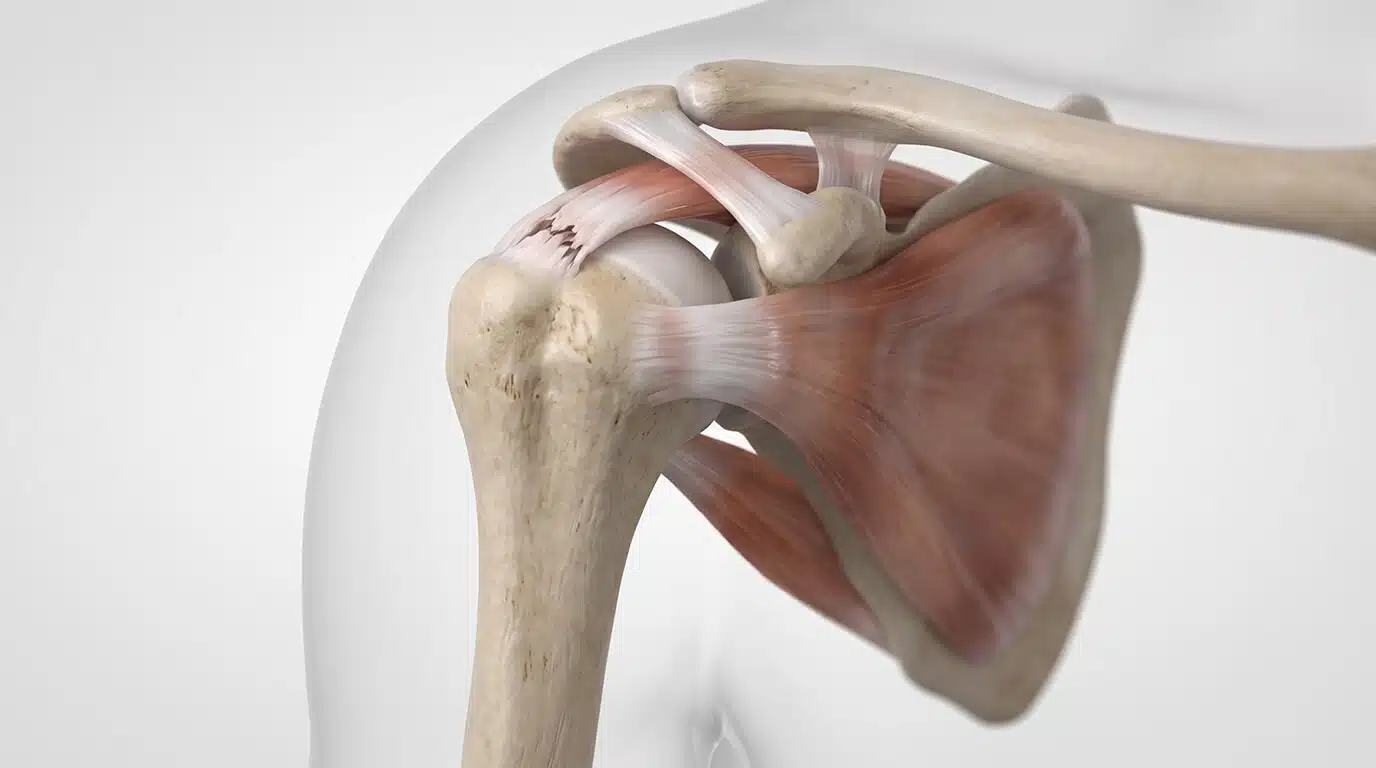
What exactly is the rotator cuff?
The rotator cuff consists of four muscles and their tendons. You can think of it as a kind of “sleeve” around the head of the humerus. It ensures that the shoulder remains stable and allows us to lift, rotate, and move our arm overhead. Without these tendons, many everyday tasks—such as combing your hair, putting on a jacket, or reaching for something on a shelf—would be nearly impossible.
If one of these tendons tears, it may cause pain, but it doesn’t have to. Some people first notice it at night, when they can no longer lie on their shoulder. Others experience pain when raising their arm or notice a sudden loss of strength—for example, when carrying groceries or lifting a case of drinks.
How does a rotator cuff tear occur?
Generally speaking, there are two common causes.
The first is an accident. For example, a fall onto an outstretched arm or a dislocated shoulder. In such cases, a tendon that is otherwise healthy can suddenly tear. We tend to see this more often in younger or physically active people.
Much more often, however, the tear develops gradually due to wear and tear. As we age, tendons become more sensitive, receive less blood flow, and are therefore more vulnerable. Even a completely normal everyday movement can then be enough to cause a pre-damaged tendon to tear. Many patients then say, “I didn’t really do anything out of the ordinary.”
When is treatment without surgery sufficient?
The good news is: Many rotator cuff tears do not require immediate surgery.
If the shoulder still has a good range of motion, the pain is manageable, and there is no significant loss of strength, we usually start with conservative treatment.
The most important part of this is physical therapy. It helps strengthen the surrounding muscles and restore stability to the shoulder. In addition, pain relievers or, in some cases, an injection can help alleviate acute symptoms. The goal is always to enable you to use your shoulder as well as possible and with minimal pain in your daily life.
An important point: You shouldn’t just rest your shoulder. Many people think that rest is the best remedy—but that’s only partly true. If you don’t move your shoulder enough, it can quickly become stiff, which often leads to even more problems. That’s why targeted exercise under professional guidance is very important.
Can a torn tendon heal on its own?
We hear this question all the time.
The clear answer is: No. A torn tendon usually does not reattach to the bone on its own.
However, that doesn’t automatically mean surgery is necessary. Many people are still able to function well in their daily lives if the surrounding muscles are well-trained. That’s why we treat not only the MRI findings, but above all the person and their symptoms.
When do we recommend surgery?
There are situations in which surgery is advisable.
For example, in the case of a fresh tear following an accident, especially in younger patients. In such cases, it is often possible to successfully reattach the tendon to the bone.
We also tend to recommend surgery more often in cases of larger tears, significant loss of strength, or when symptoms do not improve despite consistent physical therapy.
Time is also an important factor: The longer a tear persists, the more the tendon can retract and the muscle can atrophy. This often makes subsequent surgery more difficult, and the results may be less favorable.
How are surgeries performed today?
Most surgeries today are performed using what is known as the “keyhole” technique (arthroscopically). This means that only small incisions are made, through which a camera and fine instruments are inserted into the shoulder.
The torn tendon is repositioned in its original place and secured to the bone with small suture anchors. This is gentle on the tissue and usually results in good healing.
How long does it take to heal?
Many patients hope that their shoulder will be able to bear a full load again after just a few weeks. Unfortunately, it doesn’t happen that quickly.
After surgery, the shoulder is usually immobilized in a splint for about four to six weeks. At the same time, however, physical therapy begins early on. At first, only gentle, passive movements are performed; later, active exercises and targeted muscle strengthening are introduced.
It usually takes several months for the tendon to heal completely and become stable. Patience is very important here, because putting weight on it too soon can jeopardize the healing process.
In conclusion, a rotator cuff tear does not automatically require surgery. Many patients respond very well to targeted, conservative treatment and are able to use their shoulder effectively again in their daily lives.
Whether surgery is advisable depends on many factors: the size of the tear, the severity of your symptoms, how long ago the tear occurred, and what your daily routine is like. That’s why there’s no one-size-fits-all answer.
Our advice: Don’t let the MRI results alone unsettle you. What really matters is how your shoulder feels and what you’re actually able to do in your daily life. Together, we’ll find the approach that works best for you—with the goal of achieving a shoulder that’s as pain-free as possible and can handle physical activity well.

What treatment is effective without surgery?
In many cases, we can initially treat rhizarthrosis with conservative measures.
A special thumb splint can stabilize the metacarpophalangeal joint and relieve pressure, especially during periods of heavy strain. It does not necessarily have to be worn all day, but can be used as needed.
In cases of acute symptoms, anti-inflammatory pain relievers may be helpful on a temporary basis, provided there are no medical contraindications.
Heat or cold can also be soothing. Which one works better varies from person to person. When osteoarthritis is acutely inflamed and swollen, many patients find cold more soothing.
Targeted hand therapy or occupational therapy can also help maintain hand function for as long as possible.
Do injections help with rhizarthrosis?
Injections may also be an option in certain situations.
In cases of severely inflamed or active osteoarthritis, for example, cortisone can temporarily reduce inflammation and, as a result, alleviate pain.
This can be helpful, especially during a period of acute pain. However, an injection does not cure osteoarthritis or restore lost cartilage.
That is why we decide on a case-by-case basis whether an injection is appropriate and what benefits we can expect from it.
Can the cartilage in the thumb’s saddle joint regenerate?
According to current medical knowledge, severely damaged joint cartilage does not simply regenerate completely.
However, that doesn’t mean the symptoms will necessarily get worse.
Osteoarthritis and pain do not always go hand in hand. There are patients with significant rhizarthrosis who are able to manage their daily lives well for a long time.
The goal of treatment, therefore, is not to make an X-ray look “normal” again. We want to reduce pain and ensure that you can use your thumb as well and as strongly as possible.
When do we recommend surgery?
Surgery is primarily considered when the pain is consistently severe and conservative treatments no longer provide sufficient relief.
The key factor is the degree of limitation in daily life. For example, if opening a bottle, getting dressed, writing, or performing other normal tasks are still barely possible despite treatment, surgery may be a good option.
There are various surgical procedures available.
A procedure that has been in use for many years involves removing the small carpal bone affected by osteoarthritis—the large polygonal bone. The thumb is then stabilized so that it can continue to move and bear weight normally. Depending on the findings and the surgeon, different variations of this procedure may be considered.
Other surgical options may also be appropriate in certain situations. The choice of procedure depends, among other things, on the patient’s age, the findings, the stability of the joint, and the individual functional requirements of the hand.

Part of Ortivity Network