OZMO – Orthopedic Center Munich East
Your innovative specialist center for orthopedics
Here you can find us, we are looking forward to your visit.
More about medical services at OZMO.
We work closely with the Radiological Center Munich East
Mobility and agility are cornerstones of quality of life. At the Orthopaedic Center Munich East, your health is the center of attention. We look after you with a team of experts in a class of its own: three highly qualified specialists who, thanks to many years of experience and comprehensive training and further education, are esteemed specialists who have won many awards.
Our wide-ranging expertise in orthopedics and an experienced eye for your needs are the basis for our customized diagnostics and treatment. We rely on the most modern examination and treatment methods, which we pursue with the highest standards at the Orthopädie Zentrum München Ost.
surgical interventions
successful treatments
Years experience
We are three highly qualified and experienced orthopedic specialists. We are at your disposal for comprehensive diagnostic clarification and efficient treatments for all complaints of the musculoskeletal system. As experts, we bring various focal points to our service portfolio, which benefits from our extensive experience and a high level of expertise in treatment.
Supported by a great practice team consisting of colleagues, medical assistants and a modern practice management, we take care of you from the first contact to the best possible treatment result. All our patients receive first-class treatment at our locations in Munich Haar and Munich Bogenhausen. Trust in our expertise and book your appointment at the Orthopädie Zentrum München Ost (OZMO).

Specialist in orthopedics
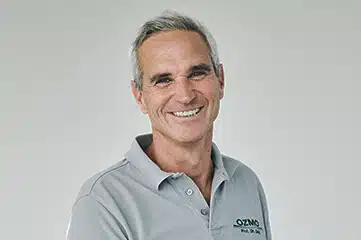
Specialist for Orthopedics & Trauma Surgery
Head physician for minimally invasive surgery Dr. Lubos Klinik Bogenhausen
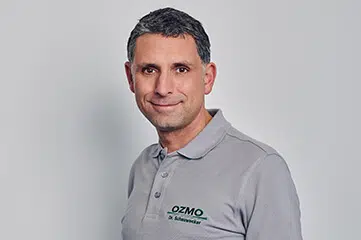
Specialist for Orthopedics & Trauma Surgery
Chief Physician Dr. Lubos Bogenhausen Clinic
With our team of three accomplished specialists, we represent the wide variety of state-of-the-art treatment options for orthopedic conditions and diseases. With many years of experience and a wide range of know-how, we not only bring you innovative therapies to choose from, but also go directly to the cause in the treatment. Treated from the root, symptoms can often not only be alleviated, but the symptoms can be eliminated from the ground up. If this option is not available, we provide the best possible results using the most modern treatment methods to bring back your health and mobility.
20,000 treatments and 1,000 surgical procedures in the specialty of orthopedics per year speak for our experience. Find out for yourself at your appointment why so many patients already trust us. We are always looking for the best treatment methods for you to help you return to a symptom-free life quickly. Thus, it is always our goal to exhaust all/s non-surgical treatments before recommending and performing surgery ourselves.
For necessary surgical treatments, we prefer gentle, minimally invasive techniques of modern orthopedics, which provide the best conditions for the healing process. An inpatient stay is thus often no longer necessary, or only for a short time. This ensures a quick return to independence and mobility, as well as facilitating a rapid return to work or a return to sports activities.
At the Orthopaedic Center Munich East, we also cover the special field of orthopaedic diseases in children and adolescents with the highest level of expertise in order to promote optimal conditions for healthy and active mobility at an early age.
At the Orthopaedic Center Munich East (OZMO), we not only work for your health in orthopaedic complaints and diseases in the classic everyday practice. We see ourselves as your modern specialist service provider from consultation to the best possible treatment in all the steps that modern medicine makes possible in orthopedics. The efficiency of the steps right from the start is also important to us: In our Orthopaedic Center, you receive almost all services under one roof, from the initial examination to the final treatment as well as long-term care for chronic illnesses.
The innovative practice concept integrates high-quality diagnostics with state-of-the-art medical technology. Even examinations with MRI for fast and radiation-free imaging, radiological shock wave therapies, bone density measurements or magnetic field therapy and many other diagnostic possibilities and treatment options take place directly on site with us. Continuous training also ensures that we always keep our high level of expertise and experience as specialists in orthopedics up to date with the latest science and research, and that we also participate in the further development of innovative treatments ourselves.
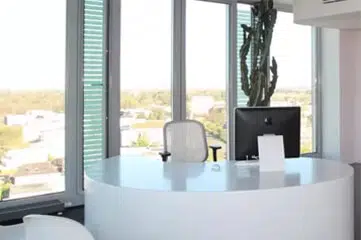
Münchener Straße 14 (11th floor in the tower at the Jagdfeld Center)
85540 Haar
Phone: +49 (0) 89 4141 434 – 64
Fax: +49 89 45 49 – 39
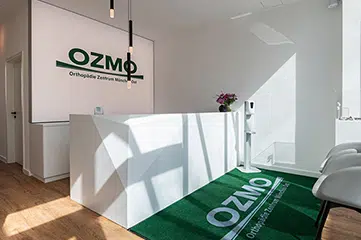
Denninger street 15
81679 Munich
Phone: +49 (0) 89 4141 434 – 64
Fax: +49 89 45 49 – 39
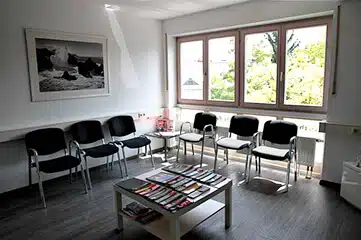
Sonnenstraße 26b
85622 Feldkirchen
Phone: +49 (0) 89 90 31 21 4
Fax: +49 89 45 49 – 39
Benefit from our expertise and our competent practice structure for all questions and problems in orthopedics. Modern equipment contributes to our rapid diagnostics and fast treatment results. Get advice on innovative therapy methods and make your appointment at the Orthopädie Zentrum München Ost in a timely manner.
Appointments at the Orthopädie Zentrum München Ost can be made online or via our call center – also for short-term appointments and emergency appointments.
In-house MRI for fast, same-day radiation-free imaging, radial and focused shock wave therapy, magnetic therapy, bone densitometry and more.
All colleagues are former senior physicians of renowned university hospitals, 20,000 treatments and 1,000 surgical procedures per year, academic teaching practice of the TU Munich.
Comprehensive non-surgical treatment options, gentle bioregenerative arthritis therapy, minimally invasive surgical techniques.
Our goal is to exhaust non-surgical treatment options first wherever possible. We offer all conservative therapy methods for the treatment of diseases of the musculoskeletal system. For necessary surgical treatments, we prefer gentle, minimally invasive techniques. An inpatient stay is thus often no longer necessary, or only for a short time. This ensures rapid independence and mobility and facilitates rapid reintegration into the workplace or return to sports activities. We also cover the specialty of orthopedic diseases in children and adolescents at the Orthopedic Center Munich East.
 https://www.orthopaediezentrum-muenchenost.de/wp-content/uploads/2026/09/hueftschmerzen-orthopaede-muenchen-ozmo-praxis.jpg
768
1376
Johannes Schauwecker
https://www.orthopaediezentrum-muenchenost.de/wp-content/uploads/2021/12/ozmo-logo-web.png
Johannes Schauwecker2026-09-23 08:00:002026-10-08 13:17:54Properly Diagnosing and Treating Hip Pain
https://www.orthopaediezentrum-muenchenost.de/wp-content/uploads/2026/09/hueftschmerzen-orthopaede-muenchen-ozmo-praxis.jpg
768
1376
Johannes Schauwecker
https://www.orthopaediezentrum-muenchenost.de/wp-content/uploads/2021/12/ozmo-logo-web.png
Johannes Schauwecker2026-09-23 08:00:002026-10-08 13:17:54Properly Diagnosing and Treating Hip Pain https://www.orthopaediezentrum-muenchenost.de/wp-content/uploads/2026/06/ozmo-blog-hueftarthrose-10.jpg
768
1376
Johannes Schauwecker
https://www.orthopaediezentrum-muenchenost.de/wp-content/uploads/2021/12/ozmo-logo-web.png
Johannes Schauwecker2026-09-18 10:22:152026-10-08 13:25:48Understanding hip osteoarthritis and treating it on an individual basis
https://www.orthopaediezentrum-muenchenost.de/wp-content/uploads/2026/06/ozmo-blog-hueftarthrose-10.jpg
768
1376
Johannes Schauwecker
https://www.orthopaediezentrum-muenchenost.de/wp-content/uploads/2021/12/ozmo-logo-web.png
Johannes Schauwecker2026-09-18 10:22:152026-10-08 13:25:48Understanding hip osteoarthritis and treating it on an individual basis https://www.orthopaediezentrum-muenchenost.de/wp-content/uploads/2026/09/schulterschmerzen-behandlung-orthopaedie-zentrum-muenchen-ost.jpg
768
1376
Peter Diehl
https://www.orthopaediezentrum-muenchenost.de/wp-content/uploads/2021/12/ozmo-logo-web.png
Peter Diehl2026-09-18 10:04:512026-10-21 14:09:12Pain-Free Shoulders – Identifying Causes, Treating Symptoms Targetedly
https://www.orthopaediezentrum-muenchenost.de/wp-content/uploads/2026/09/schulterschmerzen-behandlung-orthopaedie-zentrum-muenchen-ost.jpg
768
1376
Peter Diehl
https://www.orthopaediezentrum-muenchenost.de/wp-content/uploads/2021/12/ozmo-logo-web.png
Peter Diehl2026-09-18 10:04:512026-10-21 14:09:12Pain-Free Shoulders – Identifying Causes, Treating Symptoms TargetedlyDiseases and conditions requiring orthopedic treatment limit quality of life. We want to give you back this quality of life and offer you short distances instead of long waiting times. You will find diagnostics & treatment under one roof with professional structures and optimal conditions for individual care. We are also happy to provide you with a competent second opinion with our diverse expertise in orthopaedics. Call or text us today for your appointment at your specialty orthopedic center, Orthopädie Zentrum München Ost (OZMO).
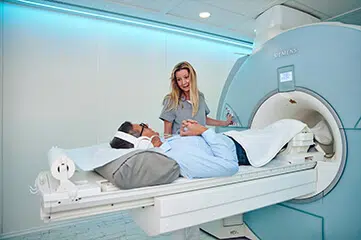
Magnetic resonance imaging (MRI) is a modern imaging technique that enables comprehensive and precise clarification of orthopedic complaints without radiation exposure. As a rule, we can provide our patients with an MRI diagnosis and subsequent discussion of the findings on the same day, thus avoiding inconvenient follow-up appointments.
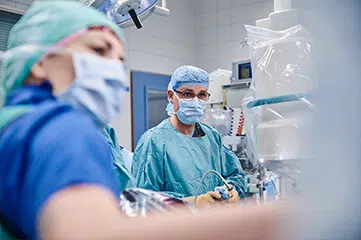
Thanks to gentle injection techniques and surgical procedures, which can often be performed on an outpatient basis or with a short inpatient stay, our patients are quickly independent, mobile and symptom-free again.
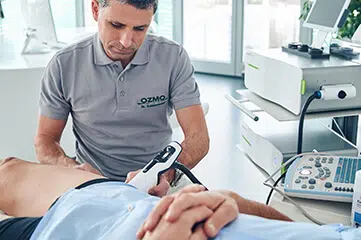
In addition to the widely used radial, we also have the much more effective focused shock wave therapy. Thanks to this treatment technique, numerous orthopedic complaints in the area of tendon insertions, fascia and musculature can be treated gently and effectively, often avoiding surgery.

Part of Ortivity Network

You need to load content from reCAPTCHA to submit the form. Please note that doing so will share data with third-party providers.
More InformationYou are currently viewing a placeholder content from Facebook. To access the actual content, click the button below. Please note that doing so will share data with third-party providers.
More InformationYou are currently viewing a placeholder content from TrustIndex. To access the actual content, click the button below. Please note that doing so will share data with third-party providers.
More Information