Carpal Tunnel Syndrome: Is Surgery Always Necessary?
Questions from Our Patients


This is one of the most common questions we hear during our office hours: “My hand constantly goes numb at night, and I’ve been diagnosed with carpal tunnel syndrome. Do I need surgery now?”
Our answer is: No, not every case of carpal tunnel syndrome requires immediate surgery. Especially in the early stages, symptoms can often be treated initially without surgery. However, the key factors are how severely the nerve is already compressed, how long the symptoms have persisted, and whether there are already sensory disturbances or a loss of strength.
Because one thing is important: You shouldn’t simply ignore carpal tunnel syndrome for an extended period of time. If the nerve is severely compressed over a long period, it can be damaged—and this damage may not be fully reversible even with surgery later on.

Dr. med. F. Meinhard Balensiefen ist Facharzt für Orthopädie, Mitgründer des OZMO – Orthopädie Zentrum München Ost und Mannschaftsarzt der Eishockeymannschaft des EHC Red Bull München. Seine Behandlungsschwerpunkte umfassen Sportmedizin, Hand- und Fußchirurgie, Endoprothetik sowie Kinderorthopädie. Darüber hinaus ist er auf die Diagnostik und Therapie von Osteoporose und Knochenstoffwechselerkrankungen spezialisiert.

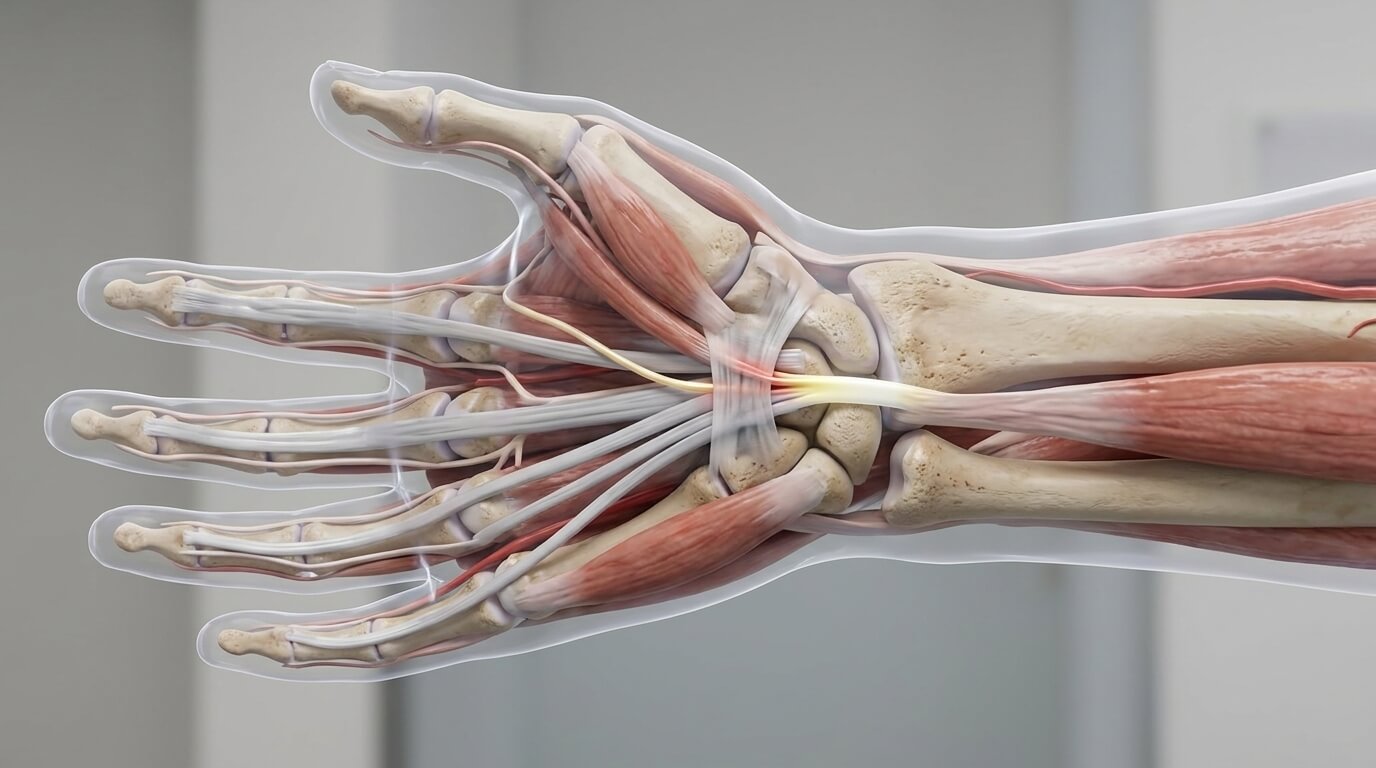
The carpal tunnel is located on the inside of the wrist. You can think of it as a relatively narrow tunnel through which several flexor tendons and an important nerve—the median nerve—pass.
Among other things, this nerve is responsible for our ability to feel our thumb, index finger, and middle finger—as well as part of the ring finger—properly. It also controls certain muscles in the thumb.
The problem: There isn’t much space in the carpal tunnel. When the tissue there swells or the tunnel narrows for other reasons, pressure on the median nerve increases. That is exactly when the typical symptoms occur.
At first, the symptoms often occur at night. Many patients tell us, “I wake up because my hand has gone numb.”
Typical symptoms include tingling, numbness, or an unpleasant pins-and-needles sensation, especially in the thumb, index finger, and middle finger. Some people also experience pain that can radiate from the wrist into the forearm or even further up the arm.
Many people automatically try to shake out or move their hand at night. This often does make things feel better for a short time.
Later on, the symptoms may also occur during the day—for example, while riding a bike, driving, talking on the phone, or holding something in your hand for a long time.
If carpal tunnel syndrome continues to progress, muscle strength may eventually decline as well. Objects may suddenly slip out of your hand, it may become harder to open bottles, or tasks requiring fine motor skills may become more difficult.
Often, there isn’t just one trigger.
In general, carpal tunnel syndrome occurs when pressure in the carpal tunnel increases and the median nerve becomes compressed. Women are affected more often than men, and the risk increases with age.
Hormonal changes can also play a role. That is why carpal tunnel syndrome, for example, occurs more frequently during pregnancy. Fluid retention can cause the already narrow carpal tunnel to become even narrower. After pregnancy, the symptoms often go away.
Conditions such as diabetes, thyroid disorders, or rheumatic diseases can also increase the risk. Changes resulting from wrist injuries can also play a role.
Sometimes, however, it is not possible to identify a clear cause at all.
How do we make the diagnosis?
The symptoms usually provide us with important clues. In addition, we examine the hand and assess sensation, range of motion, and strength.
It is also important to measure nerve conduction velocity. This test examines how quickly the median nerve transmits electrical impulses. If the nerve is compressed in the carpal tunnel, transmission is typically slower.
This examination also helps us assess how severe the nerve damage already is.
Not every numb hand is automatically a sign of carpal tunnel syndrome. Similar symptoms can also stem from the cervical spine or other nerve constrictions, for example. That is why an accurate diagnosis is important.
When is treatment without surgery sufficient?
In cases of mild carpal tunnel syndrome without persistent sensory disturbances or significant loss of strength, conservative treatment may be appropriate as a first step.
One of the most important measures is wearing a special wrist splint at night. Many people sleep with their wrists bent. This makes the carpal tunnel even narrower and increases the pressure on the nerve.
The splint keeps the wrist as straight as possible, which can reduce pressure on the nerve. This is often surprisingly effective, especially for nighttime symptoms.
In addition, it may be helpful to temporarily reduce certain activities. A cortisone injection into the carpal tunnel area can also provide significant temporary relief from the symptoms.
It is important to note, however, that these measures do not permanently resolve a significant mechanical compression of the nerve.

That depends on the cause.
If carpal tunnel syndrome develops, for example, during pregnancy due to fluid retention, the symptoms may disappear completely after childbirth.
The situation is different in cases of permanent anatomical constriction. In such cases, the nerve may temporarily calm down and the symptoms may fluctuate. However, the actual constriction remains.
For this reason, it is important to have regular checkups—especially if symptoms worsen—to determine whether nerve function is deteriorating.
We generally recommend surgery if symptoms persist despite conservative treatment or if significant neurological deficits are already present.
We take persistent numbness and progressive loss of strength particularly seriously. Even if the muscles at the base of the thumb are visibly wasting away, you shouldn’t wait much longer.
Because that’s when the body signals to us that the nerve has already sustained more severe damage.
A significantly slowed nerve conduction velocity can also be a reason to recommend surgery.
The goal of the surgery is not just to relieve pain and tingling. Above all, we want to prevent permanent damage to the median nerve.
Surgery for carpal tunnel syndrome is one of the most common hand procedures.
During the procedure, the so-called carpal ligament is cut. This ligament essentially forms the roof of the carpal tunnel. When it is cut, more space is created and the pressure on the median nerve is relieved.
The procedure can be performed open surgery via a small incision in the skin or endoscopically, that is, using a small camera. Which method is appropriate depends, among other things, on the individual findings and the surgeon’s experience.
The key point is the same for both procedures: the nerve must be reliably relieved.
move again. In fact, that’s exactly what we want.
However, you should take it easy on your hand during the first few days and keep it elevated as much as possible. The wound needs time to heal, so you should avoid putting too much strain on it at first.
When you can return to work depends largely on your occupation. People who work primarily at a desk can often return sooner than those who do physical labor and put a lot of strain on their hands.
Even full strength won’t return overnight. The area around the scar and the palms of the hands, in particular, may remain sensitive for a few more weeks.
The nighttime tingling often improves very quickly after a successful surgery. In cases of prolonged numbness, however, it may take weeks or months for the nerve to recover.
And this is precisely where an important point lies: If the nerve has already been severely damaged over a long period of time, sensory disturbances or loss of strength may persist in some cases despite a technically successful surgery.
In conclusion, carpal tunnel syndrome does not automatically require surgery. Especially in cases of mild symptoms, treatment with a night splint and adjustments to the level of strain may be entirely sufficient at first.
However, if numbness persists, strength decreases, or tests already show significant nerve damage, you should not wait too long to have surgery.
Our advice: Take a hand that regularly goes numb or feels tingly seriously—especially if the symptoms no longer occur only at night. What matters isn’t just how uncomfortable the tingling is, but whether the nerve is already being compressed.
The sooner we can determine the severity of carpal tunnel syndrome, the better we can work together to decide on the most appropriate treatment—with the goal of relieving pain and numbness and, above all, preserving the function of your hand in the long term.
All images were created using AI

Part of Ortivity Network



 Properly Diagnosing and Treating Hip Pain
You need to load content from reCAPTCHA to submit the form. Please note that doing so will share data with third-party providers.
More InformationYou are currently viewing a placeholder content from Facebook. To access the actual content, click the button below. Please note that doing so will share data with third-party providers.
More InformationYou are currently viewing a placeholder content from TrustIndex. To access the actual content, click the button below. Please note that doing so will share data with third-party providers.
More Information