
Knee pain is one of the most common reasons people visit an orthopaedic practice. That is no coincidence: the knee carries your body weight with every step, and when climbing stairs, running or jumping it carries a multiple of it. No other joint has to provide so much stability and so much mobility at the same time.
Anyone who notices first symptoms usually has the same questions: Is it harmless? When should I see a doctor? And what can I do myself so that it does not get worse? In this guide, PD Dr. Johannes Schauwecker, specialist in orthopaedics and trauma surgery at the Orthopaedic Center Munich East, explains how the knee joint is built, which warning signs you should take seriously and how to protect your knees in everyday life.

Priv.-Doz. Dr. med. habil. Johannes Schauwecker ist Facharzt für Orthopädie und Unfallchirurgie sowie Ärztlicher Leiter und Geschäftsführer des OZMO – Orthopädie Zentrum München Ost. Seine Schwerpunkte liegen in der Behandlung von Erkrankungen des Hüft- und Kniegelenks. Dabei stehen gelenkerhaltende Verfahren sowie moderne, individuell abgestimmte Methoden des Gelenkersatzes im Mittelpunkt.
At a glance
The key facts in brief
- Knee pain has many causes: overuse, injury, wear and tear or inflammation.
- Start-up pain is the most typical early sign of knee osteoarthritis.
- Strong muscles are the most important natural protection for the knee.
- Joint-friendly sports such as cycling and swimming keep the cartilage healthy.
- If pain lasts longer than a week, have your knee examined.
How the knee joint is built

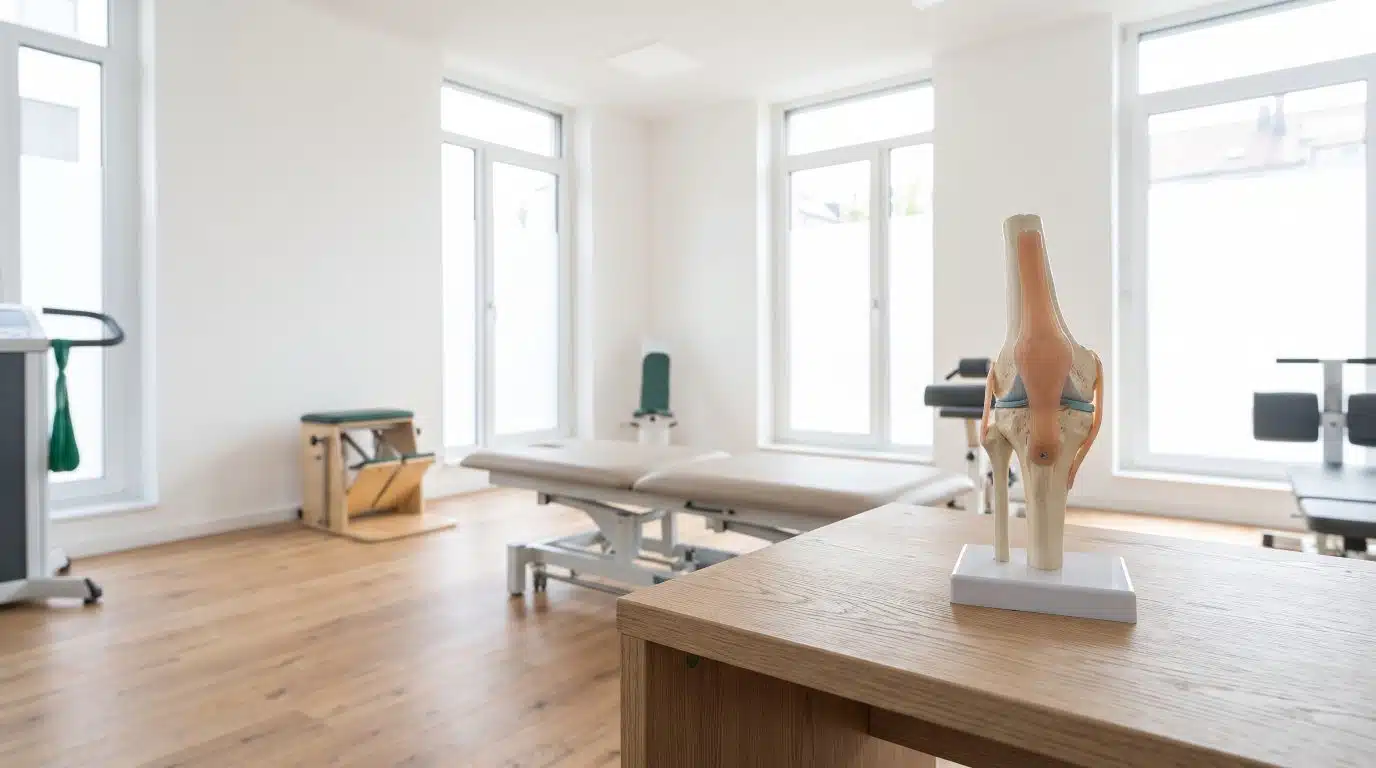
The knee joint is the largest joint in the body. It connects the thigh bone with the shin bone, and the kneecap sits at the front. Functionally, it is a hinge joint with a rotational component: it bends and straightens, and when bent it allows a slight rotation.
Key structures at a glance
- Bones: thigh bone, shin bone and kneecap
- Articular cartilage: covers the joint surfaces and ensures low-friction movement
- Two menisci: crescent-shaped fibrocartilage discs that act as shock absorbers
- Ligaments: two cruciate ligaments and two collateral ligaments for stability
- Joint capsule with synovial fluid that nourishes the cartilage
- Muscles that actively guide and relieve the joint
Menisci: the knee’s shock absorbers
The inner and outer meniscus sit between the thigh and the shin bone. They compensate for the differently shaped joint surfaces, enlarge the contact area and distribute pressure evenly. Without menisci, the load would rest on a small area and the cartilage would wear out faster. They also help to spread synovial fluid over the cartilage.
Ligaments: stability with every movement
The two cruciate ligaments run inside the joint. The anterior cruciate ligament prevents the shin bone from sliding forwards, the posterior one prevents it from sliding backwards. They are under particular strain during sudden stops and turns, which is why a cruciate ligament tear is a typical sports injury. The medial and lateral collateral ligaments protect the knee from buckling sideways. The patellar tendon transfers the force of the thigh muscles to the lower leg.
Early warning signs of knee osteoarthritis

Knee osteoarthritis (gonarthrosis) usually develops over years. The cartilage becomes rough, thinner and cracked, and in advanced stages the bones rub against each other. The first symptoms are often dismissed as a normal sign of ageing. Yet it pays to take a close look early: the sooner the cause is clear, the more options there are to slow down progression.
Typical early warning signs
- Start-up pain after sitting or in the morning after getting up
- Pain when climbing stairs, especially when going down
- Stiffness until the knee gets going
- Grinding or crunching in the joint
- Increasingly restricted mobility
- Swelling after greater strain
Start-up pain
Start-up pain is considered the most typical early sign. It occurs with the first steps after a period of rest, for example after sitting in the office or in the car for a long time, and eases after a few minutes of movement. The reason: the altered cartilage is less elastic after rest, and only movement distributes the synovial fluid again.
Interpreting pain under load
Pain under load usually comes later. Unlike start-up pain, it increases with continued activity, for example during long walks, when walking downhill or when carrying heavy loads. If it occurs regularly or gets worse, an orthopaedic specialist should clarify the cause.
What you can do about pain under load
- Observe which movements trigger the pain and make a note of it.
- Take pain seriously if it lasts longer than a week.
- Keep moving, but choose joint-friendly activities.
- Avoid overloading without resting the knee completely.
- Have increasing symptoms examined promptly.
Common causes of knee pain
Knee pain has many possible causes. Roughly speaking, they can be divided into four groups, each affecting different people and requiring different treatment.
| Cause | Typical for | Examples |
|---|---|---|
| Overuse and incorrect loading | athletes, kneeling occupations, malalignment | patellar tendinopathy, runner’s knee |
| Acute injuries | sports with changes of direction, accidents | cruciate ligament tear, meniscus tear, sprain |
| Wear and tear | mainly from middle age | knee osteoarthritis (gonarthrosis) |
| Inflammation | all age groups | rheumatoid arthritis, gout |
Acute injuries
Acute injuries usually occur during sport or in an accident, typically in football, skiing or basketball. Many people feel or hear a pop, followed by severe pain, rapid swelling and often a feeling that the knee is giving way. Such injuries should be examined by a doctor promptly.
First aid after a knee injury (PRICE rule)
- Protect and rest: stop the activity immediately.
- Ice: cool for 15 to 20 minutes, never directly on the skin.
- Compression: apply an elastic bandage.
- Elevation: raise the leg above heart level.
Overuse: the creeping cause
Not every knee pain is caused by an accident. Often the knee is overstrained for weeks or months until irritation and inflammation develop. Those particularly affected are people who kneel or squat a lot at work and athletes who increase their training too quickly.
Typical risk factors
- Occupations with frequent kneeling, such as tilers or gardeners
- Intensive training without sufficient recovery
- Knock-knees or bow legs and muscular imbalances
- Excess weight
- Unsuitable footwear and hard surfaces
Orthopaedic Center Munich East
Have your knee pain checked
PD Dr. Johannes Schauwecker and our team examine your knee and discuss the right treatment with you.
Prevention: how to protect your knees

Many knee problems cannot be prevented entirely, but the risk can be reduced considerably. The most important building blocks are strong muscles, joint-friendly exercise and a healthy body weight.
The most important building blocks of prevention
- Regular strength training, two to three times a week
- Joint-friendly sports
- A healthy body weight
- Good technique in sport and knee-friendly working, for example with knee pads
- Suitable shoes and insoles if needed
Strength training for a stable knee
The muscles around the knee act like an active corset: they guide the joint and absorb impact. Particularly important are the front and back thigh muscles, the gluteal muscles and the calves. If these muscles are weak or unbalanced, more load ends up on cartilage, menisci and ligaments.
It is not about big muscles, but about strength and coordination. Which exercises suit you depends on your knee. Ideally, have a physiotherapist put together and show you a programme. Proven exercises include wall sits, glute bridges, straight leg raises, standing on one leg and calf raises.
Joint-friendly exercise
Cartilage has no blood vessels of its own. It is nourished by the alternation of loading and unloading. That is why regular movement is important, even if the knee already twinges. Sports with even, flowing movements are well suited.
Knee-friendly sports
- Swimming, especially front crawl and backstroke
- Cycling with a correctly adjusted saddle height
- Nordic walking
- Aqua fitness
- Hiking on level, soft paths
If you already have knee problems, you should rather avoid sports with hard impacts, jumps and sudden changes of direction, for example jogging on asphalt, squash, football or volleyball.
Body weight and nutrition
Every extra kilogram puts strain on the knees when walking and even more when climbing stairs. Even moderate weight loss noticeably relieves the joints and can ease symptoms. A balanced diet with plenty of vegetables, fruit, fish and nuts supports this. What matters is that the change fits into everyday life in the long term.
When to see a doctor with knee pain

Not every knee pain needs a doctor straight away. Symptoms after unusual strain often subside after a few days. However, you should not ignore certain warning signs.
Reasons for a prompt appointment with an orthopaedic specialist
- Pain that lasts longer than a week
- Swelling, redness or warmth
- Restricted mobility or stiffness
- The feeling that the knee is giving way
- Locking or catching
- Pain at rest or at night
When it has to be quick
Some signs point to a serious injury or an inflammation of the joint. In that case, seek medical help immediately, outside consultation hours in an emergency department.
Have these checked immediately
- Visible deformity of the knee after an accident
- The knee can no longer be moved or is locked
- Severe swelling with discolouration directly after an injury
- Fever with knee pain, redness and warmth
- Numbness or tingling in the lower leg or foot
- The leg cannot bear weight because of the pain
Diagnosis and treatment at OZMO

Everything starts with a conversation: When does the pain occur, how did it start, what makes it better or worse? PD Dr. Schauwecker then examines the knee: mobility, ligament stability, tenderness, swelling. Special function tests give first indications of meniscus or ligament injuries.
Imaging complements the examination when it is needed for clarification
- X-ray: shows bones, malalignment and signs of osteoarthritis
- MRI: makes menisci, ligaments and cartilage visible, without any X-rays
- Ultrasound: shows effusions, bursae and tendons, also in motion
Conservative treatment first
Most knee pain can be treated without surgery. Which therapy makes sense depends on the cause. Often it is a combination of several building blocks.
Proven conservative measures
- Physiotherapy to build strength and coordination
- Pain-relieving and anti-inflammatory medication for a limited time
- Heat or cold, depending on the symptoms
- Injections into the joint, for example with hyaluronic acid
- Aids such as supports, braces or insoles
If these measures are not enough, joint-preserving procedures such as arthroscopy or, in advanced osteoarthritis, an artificial knee joint may be considered. We make this decision together with you, after a thorough examination and only once the conservative options have been exhausted.
Orthopaedic Center Munich East
Your appointment at OZMO
Has your knee been hurting for weeks, or would you like to prevent problems? Book an appointment at one of our locations in Haar, Bogenhausen or Feldkirchen.

Frequently asked questions (FAQ)
How can knee pain be prevented?
The most effective building blocks are strong leg and hip muscles, regular joint-friendly exercise and a healthy body weight. Also avoid overloading through training that is increased too quickly without recovery.
When should I see a doctor with knee pain?
At the latest when pain lasts longer than a week or gets worse. Have swelling, redness, warmth, locking or giving way checked promptly. After an accident with severe swelling or if you have a fever, please see a doctor immediately.
Should I rest my knee when it hurts?
Shortly after an acute injury, yes. Longer rest is harmful, however: muscles weaken and the joint becomes stiffer. After the acute phase, measured, pain-adapted movement is usually better than rest.
Which exercises help with knee pain?
That depends on the cause. For acute symptoms, muscle tensing without joint movement is suitable; for chronic symptoms, strengthening the thigh and hip as well as balance exercises. Ideally, have a physiotherapist show you the exercises.
Is cracking in the knee dangerous?
Occasional cracking without pain is usually harmless. If pain, swelling or locking occur as well, an orthopaedic specialist should examine the knee.
Conclusion: Acting early pays off
Knee pain is common, but it is not inevitable. If you understand how the knee is built, know the early warning signs and keep an eye on muscles, exercise and body weight, you can do a lot for healthy knees. If symptoms persist or warning signs appear, have the cause clarified. The earlier the diagnosis, the more options there are to treat without surgery.
At the Orthopaedic Center Munich East, we examine your knee thoroughly and discuss the right path with you, at our locations in Haar, Bogenhausen and Feldkirchen.

Tailored diagnostics and treatment – at three locations in the east of Munich. For all insured and private patients.
Memberships & partners



Part of the Ortivity Network · Association doctors of the German Ice Hockey Federation
Clinic Munich
Haar
Münchener Straße 14
85540 Haar
+49 (0) 89 4141 434 – 64
Fax +49 (0) 89 45 45 49 – 39
Opening hours
| Morning | Afternoon | |
|---|---|---|
| Mon | 08:30 – 12:00 | 14:00 – 18:00 |
| Tue | 08:30 – 12:00 | – |
| Wed | 08:30 – 13:00 | – |
| Thu | 08:30 – 12:00 | 14:00 – 18:00 |
| Fri | 08:30 – 12:00 | – |
Appointments by arrangement only
Clinic Munich
Bogenhausen
Denninger Straße 15
81679 Munich
+49 (0) 89 4141 434 – 64
Fax +49 (0) 89 45 45 49 – 39
Opening hours
| Morning | Afternoon | |
|---|---|---|
| Mon | 08:30 – 12:00 | 14:00 – 18:00 |
| Tue | 08:30 – 12:00 | – |
| Wed | – | – |
| Thu | 08:30 – 12:00 | 14:00 – 18:00 |
| Fri | 08:00 – 12:00 | – |
Appointments by arrangement only
Clinic Munich
Feldkirchen
Sonnenstraße 26b
85622 Feldkirchen
+49 (0) 89 90 31 21 4
Fax +49 (0) 89 90 31 52 4
Opening hours
| Morning | Afternoon | |
|---|---|---|
| Mon | 08:00 – 12:00 | 14:00 – 17:00 |
| Tue | 08:00 – 12:00 | – |
| Wed | 08:00 – 12:00 | – |
| Thu | 08:00 – 12:00 | 14:00 – 17:00 |
| Fri | 08:00 – 12:00 | – |
Appointments by arrangement only